
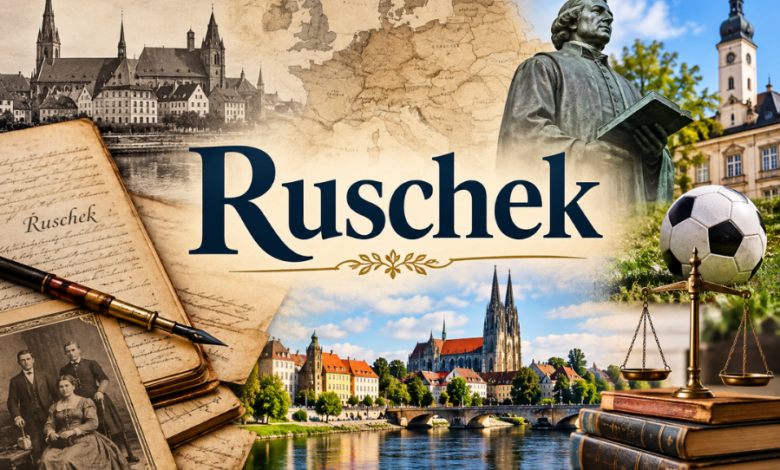
An 1840 baptismal record from Stettin, an 1887 book published in Budapest and a German football record from 1979 share one detail: the surname Ruschek. They do not necessarily describe one family, yet together they show why this uncommon name invites curiosity.
Ruschek is a surname with German roots and records beyond Germany, not one celebrity or concept. For anyone finding it in a family tree or old book, the questions concern its origins, travels and documented bearers. The answers lie less in sweeping family legends than in carefully distinguished records, preserved across languages, shifting national borders and very different professions.
A Name Shaped by the Landscape
The clearest published interpretation of Ruschek places it among German topographical surnames: names originally associated with a feature of the land. Its meaning is connected with someone who lived near a reed bed. That ordinary origin reveals how communities identified neighbours.
Before surnames became inherited, a river, woodland or wetland could distinguish neighbours. An everyday description might eventually become a permanent family identifier, passed to children long after the original landscape reference had been forgotten.
The linguistic explanation does not pinpoint a birthplace for every Ruschek family. Nor does it establish that every person using the spelling descends from one founding ancestor. Etymology explains a possible origin of a name; genealogy has the harder job of proving who belonged to a particular family.
The Same Spelling, Different Borders
One early documentary glimpse comes from Stettin, then part of Prussia and now the Polish city of Szczecin. A baptismal record identifies Auguste Louise Wilhelmine Ruschek, born in July 1840 and christened the following month. The record names her father as Johann Ruschek. That provides a dated family connection, not a universal history.
Another trace appears in the 1901 census of England and Wales. Anton Ruschek, recorded as born in Austria in 1876, appears in Shoreditch, London. It places the surname in early twentieth-century Britain. It does not establish when Anton arrived, why he moved or whether he was related to the Stettin household.
Such fragments can look tantalisingly close on a screen. Yet they belong to distinct places: a Prussian Baltic city and London. Their relationship, if any, would require documents connecting people and generations, rather than an assumption based on seven matching letters.
Why the Map Keeps Changing
The borders of Central Europe have shifted repeatedly since the nineteenth century. An ancestor described as Austrian might have been born somewhere within a much larger historical state, not necessarily inside the boundaries of today’s Austria. Likewise, a Prussian place of birth may now fall within Poland.
A census country label cannot always indicate modern nationality. Researchers need the place name, the date and the administrative geography of the period. A contradictory address might simply reflect changing borders.
Rarity Is Not the Same as a Complete Count
Ruschek is demonstrably uncommon in available surname-distribution collections. One historical distribution dataset records only a few dozen instances of the exact spelling, with Germany accounting for most of them and smaller entries for Argentina, Austria and Canada. Those figures do not count living people worldwide in 2026.
A family-history website, by contrast, can return many thousands of record matches for the name. That does not mean thousands of individuals necessarily share it today. One person can generate several matches across documents.
Archives differ dramatically in historical coverage and digitisation. An unusually low count could reflect an incomplete index as much as an uncommon spelling. The sensible conclusion is that the name is rare, not that its global population can be calculated precisely from a search page.
A Hungarian Writer Left More Than a Name
Among the most substantial historical traces is the printed work of Antal Ruschek, whose life dates are recorded as 1851–1914. Hungarian library catalogues preserve several publications under his name, providing a much firmer account of his activities than a loose collection of biographical claims could offer.
His 1887 publication A katholikus legényegylet magyar földön concerns Catholic young men’s associations in Hungary. This was a subject tied to organised religious and social life, not merely private devotion. The work occupies hundreds of pages, evidence that Ruschek engaged with a movement substantial enough to warrant extended treatment.
Another book, Betegségünk, orvosságunk, appeared in Budapest in 1892. Its catalogue description identifies it as a series of Lenten sermons. A later catalogue entry credits Ruschek with translating Louis-Émile Bougaud’s life of Saint Monica into Hungarian; a second edition appeared in Győr in 1894.
These records matter without an elaborate biography. They place a bearer of the surname inside the publishing and religious culture of historical Hungary, with works preserved for subsequent generations. A 2005 edition based on the revised Saint Monica translation shows how a translator’s name endures.
Nothing in those publication records, however, connects Antal to the Prussian family found in 1840 or to contemporary people named Ruschek. The books establish authorship and translation activity. They do not establish a shared family tree.
Five Matches Preserved in German Football History
The same surname surfaces in an entirely different setting in the German Football Association’s historical competition records. Wolfgang Ruschek, born on 4 May 1952, is associated with VfR Wormatia 08 Worms during the 1979–80 season.
The official record credits him with four appearances in the 2. Bundesliga Süd and one in the DFB-Pokal, Germany’s national cup competition. His league appearances fall between September and November 1979, while the cup appearance is dated 26 August that year.
Those figures tell a precise, limited story. They establish his presence in competitive football at that level during that season, without supporting broader claims about an extensive top-flight career, international selection or subsequent coaching positions. A name preserved in a sporting database can be historically identifiable even when the available career record is brief.
It also shows how modern digital archives change the visibility of unusual surnames. A player with only a handful of documented appearances can now be found alongside historical writers and practising professionals through a single surname search. Those results must not become one imaginary biography.
A Professional Name in Present-Day Weimar
In Weimar, Germany, Anke Ruschek’s professional practice offers another independently documented use of the name. She established her law office in May 2005, following legal studies in Jena, practical training in Erfurt and earlier work at law firms in Erfurt and Weimar.
Her professional information identifies tenancy and residential property ownership law among her principal specialisms. It records her recognition as a specialist lawyer in that field from autumn 2009. Social law and contract law are also part of the practice’s stated areas of work.
These details make the connection to the surname straightforward: it appears both in the lawyer’s personal name and in the trading name of a legal practice. It does not establish a multinational or multigenerational family enterprise.
Its professional history gives no licence to speculate about wealth or family. In a surname article, those distinctions keep an ordinary professional identity from being inflated into an invented public persona.
When Similar Names Create False Family Trees
Spelling is one of the greatest obstacles in tracing names across countries. Handwritten records, regional speech, changes of language and the judgement of individual clerks can produce variations. Researchers looking for Ruschek may therefore encounter names that look or sound close, including Ruscheck, Rutschek, Roschek or Ruscher.
Such resemblance is a reason to investigate, not a reason to merge people. Similar names can develop independently, while one family may use several spellings. Only a continuous chain of records can distinguish those possibilities.
A marriage certificate linking parents and children is more persuasive than a phonetic match. Addresses, occupations, dates of birth and witnesses can help as well. Conclusions must remain within the evidence.
Start With a Person, Not a Surname Theory
For someone researching an actual Ruschek ancestor, the best starting point is the most recent individual whose identity can be confirmed. Establish a full name, a location and an approximate date. Then work backwards through civil registration, church registers, census returns and migration records, checking each link before extending the tree.
Original images are especially valuable. An index may misread characters or abbreviate places. Viewing the underlying document can clarify a spelling and sometimes uncover an occupation, witness or household member omitted from the searchable summary.
Cross-border research may require looking for old and modern place names, as well as records in German, Hungarian or other regional languages. The aim is a defensible sequence of people and events, without forcing answers.
Why One Online Query Produces Several Stories
A search for Ruschek may return a legal practice, a football entry, historical books and genealogy databases in the same set of results. That variety reveals no single movement or personality. It reflects the way a distinctive surname becomes searchable wherever an institution has indexed it.
Context changes the answer. Someone seeing the name beside Wormatia Worms is probably looking for a footballer; someone finding it in a Hungarian book catalogue needs a historical author. The surname itself is the connecting word, not proof of a common profession, shared ancestry or coordinated activity.
Conclusion
Ruschek offers a small but revealing portrait of European naming history. Its likely landscape-based meaning reaches back to local ways of identifying people, while later records carry the spelling through Prussian, Hungarian, British and modern German settings. Writers, footballers and legal professionals have left different kinds of documentary footprints under the same name.
The interest is neither a hidden celebrity nor a definitive family tree. It is the distinction between what a surname can suggest and what a record can prove. For an uncommon name, that difference is what turns a collection of search results into reliable history.
FAQs
What does Ruschek mean?
Ruschek is generally interpreted as a German topographical surname associated with someone living near a reed bed. Such names often began as descriptions of a person’s surroundings before becoming inherited family names. The interpretation does not identify a single original household or prove that all modern bearers share one ancestor.
Is Ruschek a German or Hungarian name?
Its published linguistic interpretation is German, but people carrying the spelling appear in historical records connected with Hungary and other countries. Language of origin and individual nationality are not the same thing. A Hungarian-language publication, for example, establishes a writer’s activity in that setting, not necessarily the origin of every Ruschek family.
How common is the Ruschek surname?
Available distribution datasets place the exact spelling among uncommon surnames, with recorded occurrences concentrated largely in Germany. Their totals should be treated cautiously because coverage differs by country and date. Historical search databases can produce far more document matches than there are distinct people, so neither measure gives a definitive modern population.
Who are some documented people named Ruschek?
Antal Ruschek appears in nineteenth-century Hungarian book catalogues; Wolfgang Ruschek has recorded German football appearances in 1979; and Anke Ruschek is associated with a law practice in Weimar. These are separate documented identities. The shared surname alone gives no basis for describing them as relatives.
Can Ruschek also be spelled differently?
Researchers may encounter visually similar names such as Ruscheck, Rutschek or Roschek. Some variants could reflect transcription or migration, while others may have independent histories. Compare original records, locations, dates and verified family relationships before treating two spellings as belonging to the same ancestral line.
