
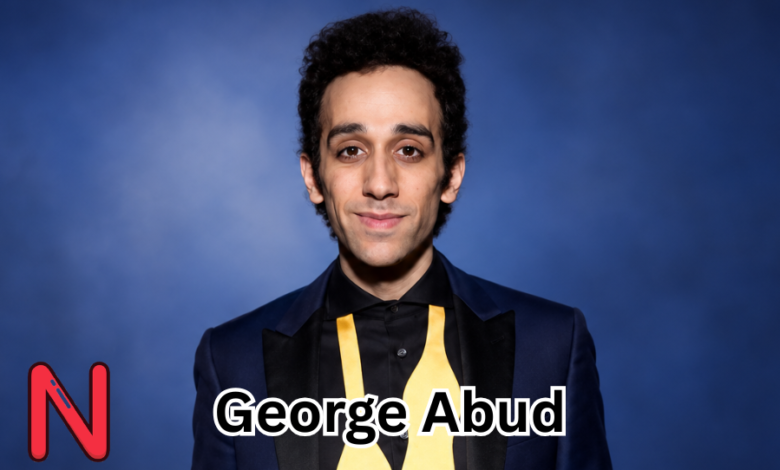
George Abud has built a career that resists a single label. He is a Broadway actor, a musician shaped by Lebanese traditions, and increasingly a playwright and director. Many theatre audiences first encountered him as Camal in The Band’s Visit. More recently, his performance as Filippo Tommaso Marinetti in Lempicka, his play The Ruins, and new directing work have widened that picture.
His recent work links performance, music, film, poetry and theatre-making, reflecting influences that shaped him long before his Broadway debut.
Quick Bio
| Detail | Information |
|---|---|
| Full Name | George Abud |
| Date of Birth | 30 October 1990 |
| Age | 35 years old, as of September 2026 |
| Birthplace | Detroit, Michigan, United States |
| Nationality | American |
| Heritage | Lebanese-American |
| Profession | Actor, playwright, director, musician and poet |
| Education | BFA in Acting, Wayne State University |
| Known For | The Band’s Visit, Lempicka, The Visit and Emojiland |
| Broadway Debut | The Visit (2015) |
| Notable Broadway Role | Camal in The Band’s Visit |
| Musical Instruments | Violin and oud |
| Notable Writing Work | The Ruins: a play through music |
| Poetry Collection | A Day and Its Night |
| Film Credit | Caught Stealing |
| Notable Recognition | 2020 Drama Desk Award nominee for Emojiland |
| Base | New York City |
A Detroit upbringing shaped by Lebanese music
Abud was born on 30 October 1990 in Detroit, Michigan. His official biography describes a childhood immersed in his family’s Lebanese culture, particularly its musical history. He studied classical violin when young, but playing Arabic music with his father and two older brothers became an important part of his early artistic life.
The oud later became especially significant. Abud has described it as closely tied to family memory and Arabic musical tradition, and it remains part of his creative identity.
Theatre entered the picture during high school. Rather than choosing between acting and music, he found that the stage could contain both. Abud went on to study acting at Wayne State University, earning a Bachelor of Fine Arts in 2012 before moving to New York City.
That combination of actor training and musicianship became a defining feature of his career.
Broadway began with The Visit
Abud made his Broadway debut in 2015 in The Visit, the John Kander and Fred Ebb musical starring Chita Rivera and Roger Rees. He played Karl Schell at the Lyceum Theatre.
His next major project brought him closer to the mix of acting, cultural identity and music that had shaped his earlier life. Abud joined The Band’s Visit, the David Yazbek and Itamar Moses musical based on Eran Kolirin’s film, as Camal.
The production first played Off-Broadway at Atlantic Theater Company before transferring to Broadway, where it opened at the Ethel Barrymore Theatre in November 2017. Abud remained in the role through September 2018.
The Band’s Visit became one of the most celebrated Broadway musicals of its season, winning 10 Tony Awards in 2018, including Best Musical. Abud’s connection to the show also brought an unusual television honour. In 2019, the cast won the Daytime Emmy Award for Outstanding Musical Performance in a Daytime Program for performing “Answer Me” on NBC’s Today. Abud was among the named members of the winning cast.
Why The Band’s Visit became a defining credit
The importance of The Band’s Visit went beyond awards. Abud was already a trained actor and musician, while the show drew heavily on Middle Eastern musical traditions, allowing several parts of his background to meet in one production.
He did not remain tied to one type of role afterwards. His Off-Broadway work has included Bertolt Brecht’s The Resistible Rise of Arturo Ui at Classic Stage Company, Cornelia Street at Atlantic Theater Company and The Beautiful Lady at La MaMa.
In 2020, Abud received a Drama Desk Award nomination for Outstanding Featured Actor in a Musical for playing Nerd Face in Emojiland. The comic performance was far removed from the restrained world of The Band’s Visit, reinforcing his ability to move between markedly different theatrical styles.
Lempicka showed another side of his stage work
A major later Broadway role arrived with Lempicka, the musical inspired by painter Tamara de Lempicka. Abud played the Italian Futurist Filippo Tommaso Marinetti when the production opened on Broadway in April 2024.
Marinetti gave him a character built around speed, provocation and ideological intensity. The performance stood in sharp contrast with Camal and highlighted a more explosive side of Abud’s stage presence.
The role reflected a broader pattern: his work often sits where theatrical form, politics, history and live music overlap.
That continued in The Untitled Unauthorized Hunter S. Thompson Musical, in which he played Richard Nixon. His work in the Signature Theatre production earned him the 2026 Helen Hayes Award for Outstanding Supporting Performer in a Musical.
The Ruins marked his move into playwriting
A major recent shift has been from interpreting other writers’ material to creating his own.
His first professionally produced play, The Ruins: a play through music, received its world premiere at the Guthrie Theater in Minneapolis in 2025. Directed by Osh Ashruf, the production starred Abud alongside Sydney Shepherd.
The play centres on two musicians who meet with a cello, an oud and books of poetry before learning they have only days to live. Structured across eight movements, it examines whether a life can feel complete and uses music as part of the dramatic language rather than as background decoration.
Abud wrote the piece in 2020, and it later developed through workshops and a New York Stage and Film residency before reaching the Guthrie. The production also helped reactivate the Guthrie’s Dowling Studio.
For Abud, The Ruins brought together interests that had previously appeared across different projects: acting, Arabic music, poetry and questions about identity, time and meaning.
Directing and adapting widened the picture
Abud’s move into authorship did not stop with playwriting. In January 2026, he adapted and directed 3Penny Opera, a new version of Brecht and Weill’s The Threepenny Opera produced by Off-Brand Opera in New York.
He also starred as Macheath. The adaptation relocated the story to present-day New York around a mayoral inauguration and brought its concerns with class, immigration and power into a contemporary setting. The cast included Katrina Lenk, reuniting Abud with his former The Band’s Visit colleague.
His writing has also moved onto the page. Abud published a poetry collection, A Day and Its Night, exploring longing, attention, self-discovery and the significance of small moments.
In August 2026, his poetry formed part of This Silent Music, an interdisciplinary performance in Philadelphia’s James Turrell Skyspace, where his words were paired with music by composer Alex Wakim.
Acting remains central, but Abud is increasingly shaping the text, structure and staging around him.
From the stage to Caught Stealing
Abud also added a notable feature-film credit in 2025, appearing as Duane in Darren Aronofsky’s Caught Stealing. The crime thriller starred Austin Butler and included Zoë Kravitz, Matt Smith, Regina King and other high-profile cast members.
The part broadened a career still centred on theatre. During the same period, Abud was developing and performing his own work while continuing major stage projects.
For viewers discovering him through the film, his stage career provides the larger context: by then, he had more than a decade of Broadway, Off-Broadway and regional work behind him.
What makes George Abud’s career distinctive
Versatility does not fully explain Abud’s trajectory. More distinctive is how his disciplines feed one another.
His Lebanese musical background informs his relationship with the oud. Musicianship strengthened his presence in music-led theatre. Acting led into writing, while poetry and live performance became structural parts of The Ruins. Directing and adaptation then gave him greater control over how those elements could work together.
The result is a broader career without abandoning its foundation. Rather than leaving acting behind, Abud is expanding what his role as a theatre artist can include.
Conclusion
George Abud’s career has expanded rather than changed direction. Acting remains the foundation, but it now supports work as a playwright, director, poet and musician.
From The Band’s Visit and Lempicka to The Ruins, 3Penny Opera and his feature-film work, his trajectory shows an artist increasingly shaping the material around him rather than only stepping into roles created by others. That is the strongest thread in his recent career: the different parts of his background now function less as separate skills and more as a connected body of work.
FAQs.
Who is George Abud?
George Abud is an American actor, playwright, director, musician and poet based in New York. He is known for Broadway productions including The Visit, The Band’s Visit and Lempicka, as well as his original play The Ruins.
How old is George Abud?
George Abud was born on 30 October 1990 in Detroit, Michigan. He is 35 years old as of September 2026 and will turn 36 in October.
What role did George Abud play in The Band’s Visit?
He originated the role of Camal in the Broadway production. Abud was also part of the cast whose performance of “Answer Me” on Today won a Daytime Emmy Award in 2019.
Does George Abud play musical instruments?
Yes. He studied classical violin and has a strong connection to Arabic music and the oud, an instrument closely associated with his Lebanese family’s musical heritage.
What is The Ruins?
The Ruins: a play through music is Abud’s first professionally produced play. It premiered at the Guthrie Theater in 2025 and follows two musicians confronting mortality through conversation, poetry and live music.
READ THIS TOO: Brian Wareing: The Chef and Teacher Who Helped Shape Marcus Wareing’s Path



One Comment