
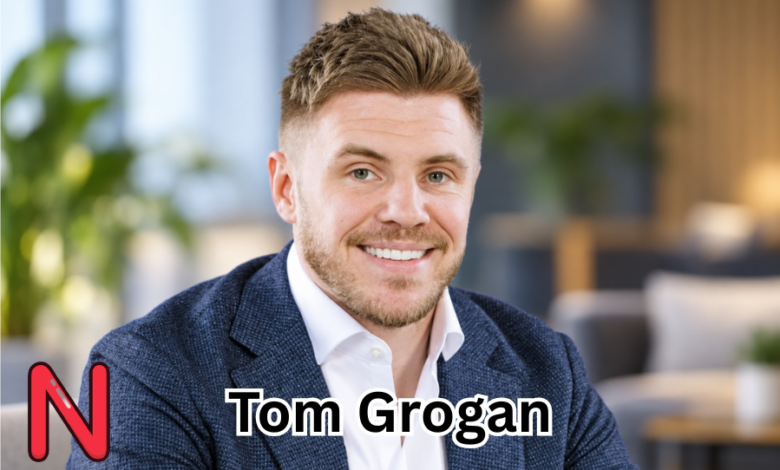
Tom Grogan’s business story did not begin in restaurants, hospitality or a university lecture hall. The British entrepreneur became best known as one of the co-founders behind Wingstop UK, helping turn an American chicken brand with no European presence into one of Britain’s fastest-growing restaurant businesses.
His path was unconventional. Grogan moved from low-paid construction work into property and private equity before spotting an opportunity in a completely different industry. The turning point was remarkably simple: an unsolicited email to Wingstop’s US headquarters. What followed involved repeated investor rejection, rapid expansion, a strong focus on youth culture and, eventually, a majority investment reportedly valuing the UK business at more than £400 million.
Quick Bio
| Detail | Information |
|---|---|
| Full Name | Tom Grogan |
| Nationality | British |
| Profession | Entrepreneur, Investor |
| Known For | Co-founding Wingstop UK |
| Company | Lemon Pepper Holdings |
| Business Partners | Herman Sahota and Saul Lewin |
| Career Background | Construction, property, private equity and hospitality |
| Major Achievement | Helped build Wingstop UK into a major nationwide restaurant business |
| Major Deal | Sixth Street acquired a majority stake in Lemon Pepper Holdings in a deal reportedly valuing the business at over £400 million |
| Current Focus | New business, finance and investment opportunities |
| Net Worth | No reliably verified public figure is available |
The Deal That Put Tom Grogan in the Spotlight
For many readers, Tom Grogan became a familiar name only after the Wingstop UK transaction attracted major business coverage.
In late 2024, global investment firm Sixth Street agreed to become the majority shareholder in Lemon Pepper Holdings, the company operating the Wingstop master franchise in the UK and Ireland. The deal was widely reported at a valuation above £400 million.
Grogan did not build it alone. Herman Sahota and Saul Lewin were his co-founders, and the three founders retained minority shareholdings after the majority investment. That distinction matters: the reported transaction value should not be treated as Grogan’s personal fortune.
Before Wingstop, There Was a Building Site
Grogan’s early working life looked very different from the corporate environment he later entered.
As a teenager, he chose work over the conventional university route and spent time on construction sites in the West Midlands. He has described earning around £30 a day while carrying bricks, moving cement and performing physically demanding labour.
A chance meeting with a property developer became a turning point. The developer acted as a mentor and introduced Grogan to a different view of business and opportunity.
That relationship eventually helped him gain experience at a private equity firm in London, where he could observe how investment proposals, funding structures and commercial deals were put together.
Those lessons later proved useful. The Wingstop venture depended not only on identifying a promising brand but also on convincing other people to finance an idea that looked risky on paper.
The Opportunity Was Hiding Outside His Industry
Grogan was not an experienced restaurateur when Wingstop entered his plans.
He and his future partners noticed that the American brand had developed a strong following in the United States while having no presence in Europe. The gap appeared commercially attractive: an established concept already had cultural recognition, but the UK market was still untouched.
In September 2016, Grogan sent a cold email to Wingstop’s headquarters in Texas proposing the idea of bringing the brand to Britain.
The company responded, opening the door to negotiations. Grogan then worked with Sahota and Lewin to turn that initial contact into a viable business.
Their lack of hospitality experience could easily have ended the project. Instead, they focused on assembling capable people, raising capital and showing that they understood how the brand could be positioned for British customers.
Fifty Rejections Before the First Restaurant
Winning the opportunity was only one part of the challenge. The founders still needed money.
Grogan has spoken about approaching investors and receiving roughly 50 rejections while trying to fund the business. Potential backers had obvious reasons to hesitate: the founders were attempting to launch a foreign restaurant brand without a track record of operating restaurants.
Eventually, the team secured the backing required to move forward. The first Wingstop UK restaurant opened at Cambridge Circus in London in 2018.
From that point, presentations gave way to staffing, supply chains, customer service and restaurant operations. The founders now had to prove that one London opening could become a repeatable national model.
Why Wingstop UK Connected With Younger Consumers
One of the most important parts of the Wingstop UK story is the way the brand was positioned after launch.
Lemon Pepper Holdings did not simply reproduce an American restaurant concept and expect it to succeed unchanged. The company placed strong emphasis on youth culture, especially music, fashion, sport and social media.
TikTok and other social platforms became important channels. Collaborations and partnerships helped Wingstop appear in spaces already familiar to younger customers, while the brand’s visual identity and flavour-led menu suited short-form digital content.
The strategy proved particularly effective with Gen Z consumers. Rather than depending only on conventional restaurant advertising, Wingstop UK developed a social identity that encouraged online conversation and gave the chain a cultural presence beyond its physical stores.
This positioning also helps explain why the founders’ lack of traditional restaurant experience was not necessarily a disadvantage. They approached part of the challenge as brand builders, not only as food operators.
Scaling From One Site to 57 Restaurants
Wingstop UK expanded quickly.
By the time the Sixth Street transaction was announced, the business had grown to 57 restaurants. Lemon Pepper Holdings reported revenue of approximately £84.7 million for the year ending in March 2024, a substantial increase on the previous period.
Growth also created a new management problem. A company with dozens of locations and a large workforce needs processes, experienced operators and leadership that can function beyond its founders.
For Grogan, the story therefore evolved from winning an opportunity to helping create an organisation capable of scaling it.
Why the £400 Million Figure Needs Context
The reported £400 million-plus value attached to the Sixth Street deal naturally led to speculation about Tom Grogan’s wealth.
There is no reliable public basis for treating that figure as his personal net worth.
The transaction involved a majority stake in Lemon Pepper Holdings, not a £400 million payment made directly to Grogan. The company had multiple founders and shareholders, and Grogan, Sahota and Lewin retained minority interests.
Simple calculations based on the headline valuation are therefore misleading.
What can be said with greater confidence is that the deal represented a major entrepreneurial exit and placed a very high value on a business the founders had built in less than a decade.
For Grogan, it also created something many founders spend years pursuing: the option to step away from full-time work.
Unexpectedly, that option raised a different question.
The Unexpected Problem With Early Retirement
After the deal, Grogan spoke openly about the adjustment that followed years of intense focus on Wingstop.
Stepping away from the daily pressure of building the company left him without the same structure or sense of purpose. He described early retirement as surprisingly boring and suggested that financial success did not automatically replace the motivation that work had provided.
Those comments attracted attention because they challenged the familiar idea that selling a successful company is the uncomplicated end point of entrepreneurship.
For seven years, the business had demanded constant attention. Once the central goal was achieved, the absence of that challenge created a void rather than permanent satisfaction.
Grogan indicated that he wanted to return to active work and explore opportunities closer to finance and investment. That may ultimately make Wingstop the first defining chapter of his career rather than the last.
Conclusion
Tom Grogan’s career is compelling because the most useful part of the story is not the size of the deal alone. It is the sequence of unlikely transitions behind it: construction work, exposure to finance, a speculative email, repeated investor rejection and entry into an industry in which he had little direct experience.
Wingstop UK became the breakthrough, but Grogan’s wider story is about recognising an opportunity and learning fast enough to make it credible. The £400 million headline explains why his name reached a wider audience. The journey before and after that deal explains why his career continues to attract interest.
FAQs.
Who is Tom Grogan?
Tom Grogan is a British entrepreneur best known for co-founding the company that introduced and expanded Wingstop in the UK. He built the business with Herman Sahota and Saul Lewin through Lemon Pepper Holdings.
Did Tom Grogan create Wingstop?
No. Wingstop was already an established American restaurant brand. Grogan and his partners secured the opportunity to bring it to Britain and built the UK franchise operation.
How did Tom Grogan get Wingstop UK?
Grogan identified that Wingstop had no European presence and sent an unsolicited email to its headquarters in Texas. That contact led to discussions, after which he and his partners worked to secure the franchise and investment.
Was Wingstop UK sold for £400 million?
Sixth Street acquired a majority stake in Lemon Pepper Holdings in a deal widely reported at more than £400 million. The founders retained minority stakes, so it was not simply a complete sale of the entire business by Grogan.
What is Tom Grogan’s net worth?
A reliably verified public net worth figure for Grogan is not available. The valuation attached to the Wingstop UK transaction should not be treated as his personal wealth because the company had multiple shareholders and only a majority stake changed hands.
READ THIS TOO: Ricky Knox: The Fintech Founder Moving From Banking to Wealth and Climate




One Comment