
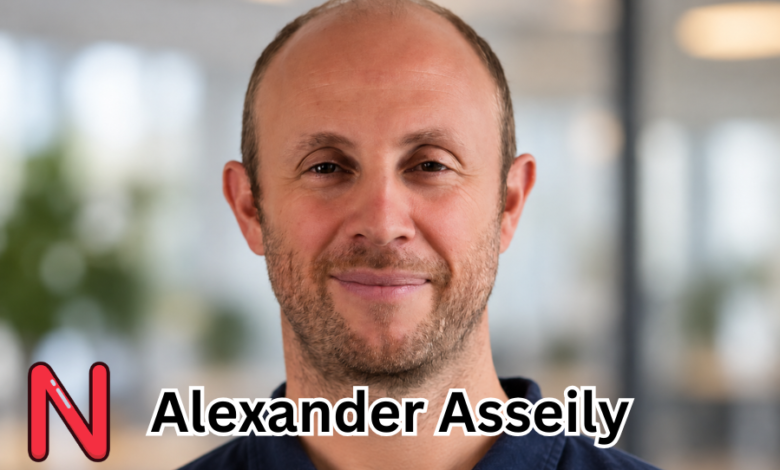
Alexander Asseily has spent more than two decades moving between consumer hardware, health technology, venture building and investment. The British-Lebanese entrepreneur is best known for co-founding Jawbone, the Silicon Valley company that helped push Bluetooth headsets, portable wireless speakers and early fitness wearables into the mainstream. Yet Jawbone is only one part of his professional story.
His later work has included the women’s health company Elvie, the opinion platform State, aviation company Lilium and Zulu Group, the venture studio he leads today. That range helps explain why interest in Asseily extends beyond a single product. His career offers a view of how design-led entrepreneurship can move from personal electronics towards health, mobility and environmental restoration.
Quick Bio
| Category | Details |
|---|---|
| Full Name | Alexander Asseily |
| Profession | Technology entrepreneur, product designer, investor |
| Nationality | British-Lebanese |
| Birth Year | 1975 |
| Birth Month | July 1975 (public company records) |
| Education | Stanford University – Product Design and Mechanical Engineering |
| Best Known For | Co-founding Jawbone (originally Aliph) |
| Major Companies | Jawbone, Elvie, State, Zulu Group |
| Current Role | Founder and CEO of Zulu Group |
| Industry Focus | Consumer technology, health technology, venture building, environmental innovation |
| Notable Products | Jawbone Bluetooth headsets, Jambox wireless speakers, UP fitness trackers |
| Investment Interests | Technology startups, health, aerospace, sustainability-focused ventures |
| Known For | Combining product design, engineering and entrepreneurship to build technology companies |
A Childhood Divided Between Lebanon and Britain
Public corporate records show that Alexander Asseily was born in July 1975. He spent his early years in Lebanon during the Lebanese Civil War before his family moved back to London while he was still a child.
In the early 1990s, he went to Stanford University, where he studied product design and mechanical engineering. The combination became important to his later work: rather than treating technology only as an engineering problem, he learned to think about how products should look, feel and fit into everyday life.
The Stanford Idea That Became Jawbone
Jawbone began as Aliph, founded by Asseily and fellow Stanford student Hosain Rahman in 1999. Its roots can be traced to Asseily’s Stanford work on a wrist-worn communication concept linked to a headset, an ambitious idea for a period when mobile devices were far less capable than today’s smartphones.
The founders initially concentrated on voice communication and noise suppression. Their work connected them with scientists at Lawrence Livermore National Laboratory and research supported by the US military’s DARPA programme. Aliph later adapted that technical foundation for consumer products, developing headsets designed to isolate the user’s voice in noisy environments.
How Design Became Part of Jawbone’s Identity
Jawbone’s importance was not simply that it made Bluetooth headsets. The company treated industrial design as a core part of consumer electronics at a time when many mobile accessories were visually forgettable.
Working with designer Yves Béhar and his studio, Jawbone developed products with distinctive shapes, materials and packaging. Asseily’s product-design background fitted naturally into that approach.
The strategy became especially visible with Jambox, introduced in 2010. The compact wireless speaker arrived as smartphones were becoming the centre of personal media, giving users a portable alternative to traditional speaker systems. Jambox became one of Jawbone’s defining products and helped establish portable Bluetooth audio as a major consumer category.
UP Placed Jawbone at the Front of the Wearable Movement
In 2011, Jawbone introduced UP, a wrist-worn tracker designed to monitor movement and sleep. It had no conventional screen, relying on a connected app to make the collected data useful.
The concept anticipated a much larger shift in technology: consumers were beginning to use connected devices not just to communicate but to measure activity, sleep and health habits.
Being early also carried costs. The first UP experienced serious reliability problems, prompting refunds and a redesign. Jawbone continued developing the category, but competition intensified as Fitbit expanded and Apple entered wearables.
Jawbone’s Collapse Became Part of the Silicon Valley Lesson
At its peak, Jawbone reached a valuation of about $3.2 billion and attracted hundreds of millions of dollars from prominent investors. The company nevertheless entered liquidation in 2017 after years of product difficulties, intense competition and high operating costs.
A later Sequoia Capital retrospective treated Jawbone as a cautionary hardware story: ambitious design and heavy funding could not compensate for product reliability and business-model problems.
For Asseily, Jawbone therefore represents both achievement and warning. The company helped shape categories that later became enormous, yet its ending showed how manufacturing quality, margins, timing and competition can determine whether hardware innovation survives.
State Explored a Different Technology Problem
Asseily had already begun broadening his focus before Jawbone’s final years. After returning to London, he co-founded State, an online opinion network designed around what people thought rather than how many followers they had.
The platform launched publicly in 2013 after raising $14 million in seed funding. Its premise was that online conversation often gives more visibility to people who already have large audiences. State attempted to organise discussion around opinions and topics instead.
The project was very different from Jawbone, but it reflected a recurring feature in Asseily’s work: identifying a familiar human activity and asking whether technology could restructure the experience.
Elvie Brought Product Design Into Women’s Health
Another major venture arrived in 2013, when women’s health specialist Tania Boler founded Elvie with Asseily as her business partner and co-founder. The company focused on areas of women’s health that had received relatively little attention from mainstream consumer-electronics businesses.
Elvie became known for connected pelvic-floor training technology and later wearable breast pumps. Its products combined sensors, software and discreet industrial design, applying a principle familiar from Jawbone: engineering becomes more useful when built around real patterns of daily behaviour.
Elvie’s company material identifies Asseily as a co-founder and chairman. In 2025, Elvie became part of the Willow family, bringing together two businesses specialising in breastfeeding technology.
Investing, Atomico and Lilium
Asseily has also worked as an investor and adviser. He joined Atomico’s Entrepreneur Partner programme, through which experienced founders contributed to the venture firm’s investment work.
One of his higher-profile later roles involved Lilium, the German electric aviation company developing an eVTOL aircraft. By 2021, Lilium identified Asseily as Vice Chairman after he had previously served in a strategy role.
Lilium’s main German subsidiaries entered insolvency proceedings in 2024 while the business pursued restructuring and new investment. Asseily’s connection to Lilium is therefore best understood as an earlier executive and strategic role rather than described as an uncomplicated current position.
Zulu Group Is Now the Centre of His Work
The clearest picture of Alexander Asseily’s present-day professional focus comes from Zulu Group. Its official material says he founded the venture studio in 2013 to build and back ambitious ideas with social and planetary impact. Business of Fashion also identifies him as the group’s founder and chief executive.
Zulu’s projects move well beyond the consumer electronics that first made Asseily known. One initiative, Zulu Ecosystems, was developed around using science, software and finance to support large-scale ecological restoration. Zulu says the concept began in 2020, with the aim of creating a common framework for landowners, scientists and financial stakeholders.
Asseily also publishes through Zulu Zephyr, writing about technology, nature, civilisation and long-term social questions. New issues appeared through 2025 and 2026, making the platform one of the clearest indicators of his current public work.
The Pattern Behind His Ventures
Across Asseily’s career, the common thread is not one industry. Jawbone focused on audio and wearables, Elvie on women’s health, State on online opinion, Lilium on electric aviation and Zulu on venture creation with social and environmental aims.
What links them is a design-oriented view of technology. The question is often not simply what a technology can do, but whether it can change an established behaviour in a way that people will actually adopt.
That approach has produced both successes and setbacks. Jawbone helped define categories that later became enormous but ultimately failed as a business. Elvie demonstrated that underserved health categories could support sophisticated consumer products. Zulu Group now applies similar entrepreneurial thinking to broader environmental and societal problems.
Conclusion
Alexander Asseily’s career is most revealing when viewed as a series of experiments in how technology enters everyday life. Jawbone put design around wireless communication, Jambox helped normalise portable Bluetooth audio, UP pushed health tracking onto the wrist, and Elvie applied connected hardware to women’s health.
The story also includes failure, reinvention and a gradual widening of focus. Today, through Zulu Group, Asseily’s attention extends beyond individual gadgets towards environmental restoration and broader social systems. That progression makes him less a founder tied to one famous startup and more a product-driven entrepreneur whose work has repeatedly tested where design, engineering and human behaviour meet.
Frequently Asked Questions
Who is Alexander Asseily?
Alexander Asseily is a British-Lebanese entrepreneur, product designer and investor. He co-founded Jawbone, later helped build Elvie and State, and is now most closely associated with Zulu Group.
How old is Alexander Asseily?
UK corporate records give his birth month as July 1975, making him 51 years old as of September 2026.
What did Alexander Asseily study at Stanford?
He studied product design and mechanical engineering at Stanford University. That combination of design and technical training became central to his later work in consumer hardware.
Did Alexander Asseily found Jawbone?
Yes. He co-founded the company that became Jawbone with Hosain Rahman in 1999. Originally known as Aliph, it developed noise-cancelling communications technology before expanding into headsets, speakers and fitness trackers.
What is Alexander Asseily doing now?
His clearest documented current role is founder and chief executive of Zulu Group, a venture studio that builds and supports projects with social or planetary aims.
READ THIS TOO: Alex Stephany: The Entrepreneur Using Technology and Crowdfunding to Tackle Social Challenges





One Comment