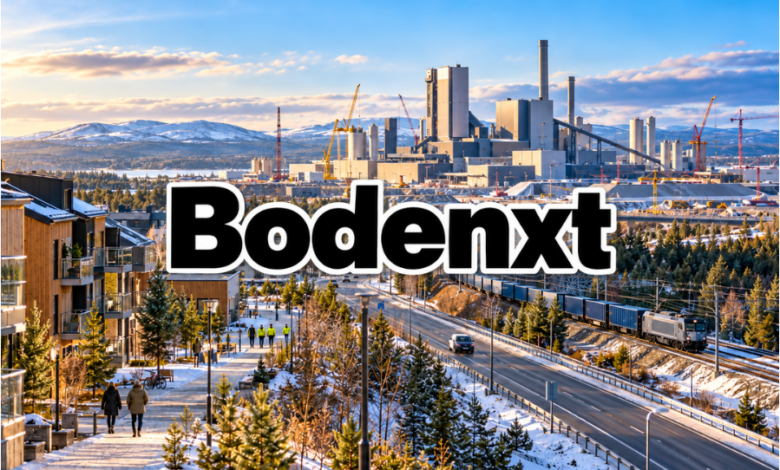
A new road opened to Boden Industrial Park in October 2026, marking another practical step in northern Sweden’s ambitious industrial expansion. Behind the road, the railway and the construction sites is Bodenxt, the Municipality of Boden’s framework for managing change across an entire community. Its purpose extends beyond attracting factories: a growing town also needs homes, skilled workers, dependable services and places where families can settle.
The initiative has become closely associated with Stegra’s major steel investment, but the story is wider than a single company. Sweden’s expanding defence sector adds another layer of demand, while an acute housing shortage shows how easily rapid growth can strain everyday life. Understanding Bodenxt means examining whether industrial ambition and local development can advance at the same pace.
More Than a Green Branding Exercise
Bodenxt is a municipal development platform, not a technology business, downloadable application or commercial AI product. Boden Municipality uses it to coordinate and communicate the work involved in its unusually rapid societal transformation. The municipality describes the scale of the change as comparable to approximately two decades of development compressed into the coming years.
The programme connects skills provision, housing and living conditions, business development and infrastructure. These areas cannot function independently. A factory may recruit an engineer, but the recruitment becomes harder if that engineer cannot rent a flat. A new residential district needs water systems, roads and services before it becomes a viable neighbourhood.
This is why the distinction between a plant and a community matters. Bodenxt does not manufacture steel or operate the defence sector. It deals with the wider consequences of investment, bringing municipal functions and external partners into a shared picture of what must happen next.
Two Engines Are Changing Boden’s Economy
Stegra and the Appeal of Lower-Emission Steel
Stegra, previously known as H2 Green Steel, is developing a large industrial operation at Boden Industrial Park. Its planned production model combines hydrogen-based ironmaking with steel production, seeking to cut emissions compared with conventional coal-dependent routes. Actual emissions reductions will depend on operations and energy supply.
The municipality estimates that Stegra’s investment could create about 3,000 direct and indirect jobs by 2029. This is a forecast, not employment already delivered. The effects would extend to contractors, shops, transport and services.
Financing has also been a genuine test of the project. In April 2026, Boden Municipality announced a financing round of approximately SEK 16 billion, equivalent to roughly €1.4 billion, intended to enable continued construction after a period of slower activity. Financing does not eliminate construction and commercial risks.
The Defence Sector Adds a Second Pressure
Boden has an established military identity, and the strengthening of Sweden’s defence capabilities is now another major driver of local development. The municipality expects staffing requirements linked to the Swedish Armed Forces in the wider region to grow by several thousand over the next two decades.
Industrial and military employers draw on some overlapping resources: technical skills, accommodation, transport capacity and public services. It also complicates planning beyond one company’s timetable.
Housing Is the Most Immediate Test
A town may have available jobs and still struggle to attract the people needed to perform them. In May 2026, Boden Municipality warned that its rental-apartment vacancy rate was close to zero. It also linked limited housing availability to difficulty recruiting and retaining residents, while noting that a small population decline in March followed ten months of growth.
Existing residents suffer too: young people struggle to rent, older residents to downsize and families to move into larger homes.
There are signs of a response, although planned homes should not be mistaken for completed ones. In September, construction began on 41 rental townhouses in Prästholmen, developed by Surewood Housing using factory-built modules. The developer aimed for tenants to move in from April 2027, a target dependent on construction proceeding as planned.
The municipality also signed a letter of intent with Lindbäcks to explore arrangements involving approximately 20 apartments in the planned Tjärnbacken development. Lindbäcks outlined a first phase of 89 rental apartments there, within a broader 180-home scheme. The letter of intent was not a final agreement, and the larger development remained a plan rather than an immediate solution to the shortage.
The Infrastructure Behind the Headlines
A Railway and Road Built for Industrial Scale
In June 2026, a six-kilometre railway connecting Boden Industrial Park with Sweden’s wider rail system was inaugurated. The first stretch of a new road opened on 1 October, linking the Svartbyn interchange on Road 97 with the boundary of Stegra’s site. These are tangible milestones because large industrial facilities depend on moving heavy materials, finished products and workers reliably.
Boden Municipality says the complete road scheme represents investment approaching SEK 500 million, with the newly opened section accounting for a little over SEK 200 million. Remaining stretches, intended to extend the connection through the industrial area, are expected to open by the end of 2027. A pedestrian and cycle route is included in the wider project.
The park is intended for other businesses too. Transport investment therefore needs to serve future users while addressing traffic, environmental effects and maintenance costs.
Less Visible Systems Need Capacity Too
Road openings attract attention; wastewater treatment rarely does. But the expansion of the Svedjan wastewater treatment plant, which began in April 2026, illustrates another requirement of fast-growing communities. Water, sanitation and other underground services must be able to support new homes and workplaces while meeting environmental standards.
Emergency preparedness is changing as well. During 2026, the municipality described cooperation with Stegra in developing an industrial emergency-response capability. A complex industrial site introduces risks and operational demands that local rescue services must understand before an incident occurs.
Turning Vacancies Into Local Careers
Large employers cannot build a lasting workforce through outside recruitment alone. Local education has to adapt, while newcomers need routes into employment and community life. In January 2026, Boden announced a new upper-secondary engineering programme at Björknäsgymnasiet, scheduled to start that autumn.
The additional technical year focuses on industrial design and product development, combining teaching with practical projects and workplace learning. The municipality named Stegra, SMS Group Nordic, LN Industrimontage and the Swedish Armed Forces among collaborating employers. It creates a local route into new careers, reducing dependence on relocation.
There is also the question of accompanying families. A specialist may accept a post, but a partner’s employment opportunities, children’s schooling and the ability to establish friendships can influence whether the household stays. Boden’s efforts to connect accompanying partners reflect that broader reality of recruitment.
What Local Businesses Stand to Gain
Major construction projects generate commercial demand that is not confined to specialist engineering suppliers. Catering, accommodation, cleaning, logistics and everyday services can all experience new opportunities. Boden Municipality has highlighted the expansion of local food business M/S Bränna from a food truck operation into a restaurant serving demand connected with the industrial park.
The test is whether businesses remain viable after temporary construction demand subsides. Supporting entrepreneurship, suppliers and complementary industrial activity is therefore as important as attracting a headline investor.
Boden Cleantech Center offers a different illustration. The proposed business area focuses on environmental technology, recycling and waste management, suggesting opportunities linked to resource efficiency rather than steel production alone. However, its development depends on planning scrutiny, environmental safeguards and the interests of nearby residents.
The Environmental Promise Meets Public Scrutiny
Green industrialisation is not automatically free of local environmental costs. Industrial land use, water management and increased transport can create tensions even when a project aims to reduce global carbon emissions. A credible transition must account for both the climate case and the effects felt by neighbouring communities.
In September 2026, Boden presented a revised planning proposal for the approximately 125-hectare Cleantech Center area. Following consultation and further studies, the proposal included an additional wetland for water management, designated around 34 hectares as natural land and addressed identified soil contamination. A new consultation period was set to run from 21 September to 22 October.
This is a useful reminder that public objections can change a development proposal. The consultation process does not guarantee agreement, but it offers a mechanism to test whether economic ambition has adequately considered water, nature and residential concerns. Credibility will depend on implementation.
A separate municipality-wide comprehensive plan, looking towards 2040, entered consultation in September. It considers where housing and commerce might expand, how transport should evolve and which areas need protection. That longer horizon matters because planning decisions made for an industrial boom can shape land use for decades.
What Bodenxt Must Deliver Next
By October 2026, Boden can point to visible progress: a functioning industrial rail connection, a first section of new road, housing schemes moving through development and education initiatives aligned with emerging employers. Progress does not mean every challenge is solved.
Three tests now stand out. Housing must become available at a pace that matches recruitment. Public infrastructure and services must keep up without compromising financial or environmental responsibilities. And the local economy needs enough diversity to remain healthy if industrial schedules, investment conditions or defence requirements change.
The strongest evidence of success will not be the size of an announcement. It will be whether residents can find homes, young people can access worthwhile jobs, businesses can operate efficiently and community services remain dependable during sustained growth.
Conclusion
Bodenxt turns a familiar economic promise into a harder civic question: what does it take for new industry to improve life beyond the factory gates? Boden’s road, rail, housing and education projects show why green transformation needs patient coordination as well as capital investment. Its housing shortage and environmental consultations show why growth also requires difficult choices.
For other industrial regions, Boden offers a useful case study, not a ready-made formula. The real achievement will be a town that functions well for the people already there and for those arriving to build its next chapter.
FAQs
What Exactly Is Bodenxt?
Bodenxt is the Municipality of Boden’s framework for coordinating the town’s societal transformation in northern Sweden. It covers practical issues connected with industrial expansion, including housing, workforce skills, business development and infrastructure. It is a public development initiative rather than a standalone company or product.
Is Bodenxt Connected to Stegra?
Yes, but the two are not the same organisation. Stegra is developing a major lower-emission steel operation at Boden Industrial Park, while Bodenxt addresses the broader changes that investment creates. Its scope also extends to other employers, municipal services and Sweden’s growing defence presence.
Can You Download Bodenxt as an App or AI Tool?
No official municipal description identifies Bodenxt as an app, AI service or subscription software. The word “platform” refers to a coordinated approach to community development. Websites that use the same name for other purposes should not be assumed to represent Boden Municipality’s initiative.
Why Is Housing Such a Serious Issue in Boden?
Rapid industrial recruitment and other growth pressures have increased demand for accommodation. In May 2026, the municipality said rental vacancies were close to zero, making relocation and ordinary household moves difficult. New housing projects are progressing, but planned construction cannot immediately provide homes for everyone who needs one.
What Changed for Bodenxt in 2026?
Key developments included the opening of an industrial railway in June, the first section of a new access road in October and progress on proposed rental housing. The municipality also advanced training programmes and public consultations on future land use, showing how industrial investment is changing local priorities.