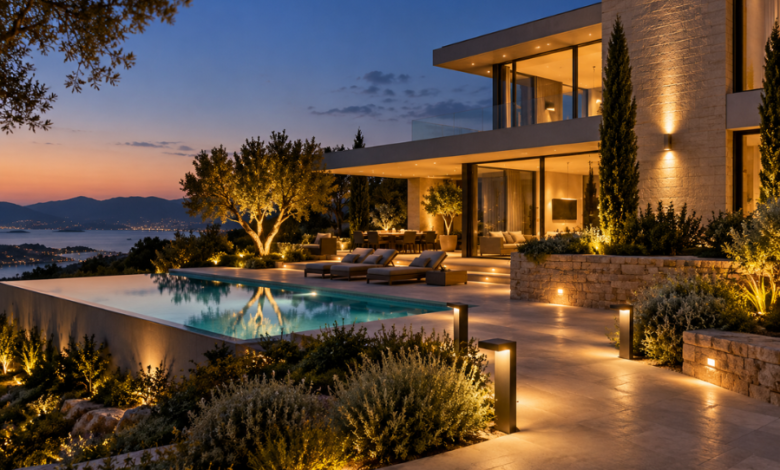
Cristher sits in a lighting category where appearance, engineering and environmental exposure all matter at once. Rather than functioning as a general home-lighting label, the Spanish brand is positioned around architectural and residential exterior illumination, with products for façades, gardens, pathways, pools and public spaces where reliability matters as much as visual effect. Today, Cristher operates within Novolux Lighting, the Barcelona-based group whose portfolio spans indoor, outdoor, decorative, technical and linear lighting. Understanding Cristher therefore means looking at the business history, technical priorities and project-led design philosophy behind the range.
Cristher Is a Specialist Brand, Not a General Lighting Label
The clearest way to understand Cristher is through its place inside Novolux Lighting. Novolux describes the brand as its higher-end offer for architectural outdoor lighting, combining design with the technical requirements of professional exterior projects.
That positioning separates Cristher from a simple catalogue of garden lamps. Outdoor lighting must deal with rain, dust, impact, temperature changes and the need to control where light falls, while also working visually with architecture and landscaping.
The current range covers surface-mounted fittings, recessed luminaires, projectors, wall-washers, bollards, columns, urban lighting and underwater products. Many families come in multiple sizes, outputs, beam angles, finishes or control configurations, allowing one design language to run through different areas of a project.
From a Family Lighting Business to the Novolux Portfolio
Cristher’s roots go back to 1981, when the business began as a family lighting company in Spain. Novolux now traces its own origins to the birth of Cristher, making the brand part of the group’s earliest commercial identity rather than a later creation.
A second outdoor lighting company, Dopo, was founded in 1990. In 2005, private-equity investors Dinamia and Nmás1 invested in Cristher and Dopo, with contemporary financial documentation describing Cristher as a leading player in Spain’s private outdoor-lighting market.
The following year brought a decisive structural change. In June 2006, shareholders approved the absorption of Cristher S.L.U. and Dopo S.L.U. into Grupo Gestión Integral Novolux Internacional. That merger explains why the Cristher name survives as a brand even though the original company became part of the wider Novolux organisation.
Novolux later broadened its portfolio. Exo developed the decorative interior offer, Indeluz added technical indoor lighting, and Canaled strengthened linear lighting. Cristher, however, retained a focused role: premium exterior lighting for residential, architectural and urban applications.
Why Cristher Has a Distinct Role Inside Novolux
Novolux gives its brands relatively clear jobs. Cristher occupies the design-led exterior end of the portfolio. Dopo also serves outdoor applications but is positioned more broadly around functional lighting, while Exo focuses on decorative interiors, Indeluz on technical indoor environments and Canaled on linear systems.
That focus shapes the range. A bollard, wall light or projector is not always treated as an isolated object; product families can provide related solutions for different mounting positions and lighting effects. Designers can therefore carry a consistent visual language across a terrace, façade, garden path or arrival area.
For larger projects, that continuity can be as useful as the appearance of any single fitting.
What Cristher Makes in 2026
The 2026 range spans several major categories and goes well beyond conventional garden lighting.
Recessed and Surface Lighting
Recessed fittings are a major part of the offer, with products designed for floors and walls. Families such as Suri, Malva, Garda, Dain and Walk appear across multiple formats. These luminaires can mark paths, graze architectural surfaces, accent planting or provide low-level orientation without placing a prominent fixture in the scene.
Surface-mounted options serve walls, ceilings and structural elements where cutting into a surface is impractical or where the fitting itself forms part of the architecture.
Having both approaches in one range gives designers flexibility while keeping factors such as finish, colour temperature and light quality consistent across a project.
Spotlights, Wall-Washers and Façade Emphasis
Cristher also has a substantial spotlight portfolio, including families such as Dado, Disc, Fuji, Gibson, Kalos, Lance, Stone and Walk.
These products address a core task in exterior lighting: putting light on a specific object or plane rather than simply increasing overall brightness. Controlled beams can highlight stonework, trees, sculptures, entrances or structural features while reducing unwanted spill.
Wall-washers perform a related job on a broader scale. Used carefully, they can create a more even visual layer across a façade or boundary surface and help architecture remain legible after dark.
Bollards, Columns and Urban Lighting
Bollards are another prominent Cristher category. Families such as Dion, Duomo, Palau, Dain, Aura and Maxima offer different heights, proportions and distributions for paths, landscaped areas, residential developments and public environments.
The catalogue also extends into pole-mounted and urban products. This moves Cristher beyond private gardens into larger spaces where lighting must support circulation and orientation while fitting the visual language of the site.
The Palau family illustrates the direction of modern outdoor lighting. Novolux highlights strong ingress and impact protection, warm colour-temperature options and optical characteristics intended to limit unnecessary upward light. The emphasis is therefore shifting from simply making outdoor spaces brighter to making illumination more controlled.
Underwater and Pool Lighting
Cristher’s underwater products add another specialist layer. The catalogue includes fittings designed for submerged use, with selected models carrying IP68 protection and configurations for white or RGB light.
This category demands more than decorative appeal. Underwater luminaires require correct voltage, sealing, materials and installation conditions, and individual products may have specific operating requirements. For pool designers and contractors, those technical details are central to selection.
The Technical Language Behind Cristher Products
Cristher’s identity is closely tied to configurable performance. Novolux presents the brand around options for dimming, optics, correlated colour temperature, LED types, luminous output and finishes built for outdoor exposure and physical impact.
That matters because exterior lighting rarely has one ideal specification. A hospitality terrace may need warm, low-glare light and dimming. A façade may require a tighter beam and greater output. A pathway may call for controlled downward distribution, while a pool fitting needs a different protection level and electrical arrangement.
Many product families therefore offer multiple lumen outputs, colour temperatures, beam spreads and control options. Some ranges support DALI dimming, a digital lighting-control standard widely used in professional projects.
Protection ratings are equally important. Cristher products appear across different IP classifications depending on their intended use, while underwater models can reach IP68. Certain outdoor families also carry impact-resistance ratings, helping specifiers match a fitting to the exposure expected on site.
Design Is Supported by Manufacturing and Project Infrastructure
Cristher’s appeal is not based on visual design alone. Novolux supports its product range with industrial design, research and development, technical advice and custom project capabilities. The company operates from Santa Perpètua de Mogoda near Barcelona, where its headquarters and logistics infrastructure form part of a 12,000-square-metre workspace.
Novolux says its logistics centre has capacity for 10,000 pallets and handles more than 200 dispatched orders a day. It also describes in-house technical and quality-control testing, engineering capability and production resources linked to product development and assembly.
The group operates a quality-management system based on ISO 9001:2015. For professional buyers, that infrastructure matters because lighting projects depend on more than attractive fittings. Documentation, repeatability, availability, technical support and quality processes can all affect whether a specified product works smoothly from design stage to installation.
Sustainability Is Reshaping Outdoor Lighting
The exterior-lighting sector is under pressure to use less energy and reduce unnecessary night-time illumination. Cristher’s development sits within that wider shift.
Novolux has emphasised local production, energy efficiency and lower-impact materials across its group strategy. It has also encouraged designers to direct light only where needed, reduce upward spill and consider warmer colour temperatures in environmentally sensitive outdoor settings.
Those ideas are particularly relevant to Cristher because exterior lighting interacts directly with streets, gardens, wildlife and neighbouring properties. More light is not automatically better light. Beam control, shielding, dimming and suitable colour temperature can make a scheme more useful while reducing glare and excessive spill.
Solar products are also becoming more visible in Novolux’s offer. Sensors, battery technology and autonomous operation can make them practical for locations where conventional electrical infrastructure is difficult or costly.
Cristher Beyond Spain
Novolux says it has an international presence in more than 40 countries through partners and distributors across Europe, the Middle East, Latin America, Africa and Asia. The group also markets products in the United States, giving Cristher relevance beyond its Spanish base.
For UK and US professionals, the interest is less about brand fame and more about specification choice. Cristher competes in a market where architects and lighting designers compare optical performance, durability, control compatibility, finish, availability and project support.
The brand’s long history gives it continuity, but its current usefulness depends on whether individual products meet the needs of a particular scheme. Architectural lighting is selected by matching photometric, electrical, environmental and aesthetic requirements to the site, not by heritage alone.
What the Name Cristher Refers To Online
The word Cristher can also appear as a personal given name, username or unrelated business name, which explains why results for the term do not always relate to lighting.
In a lighting context, however, Cristher most clearly refers to the Novolux brand founded in 1981 and now focused on higher-end architectural exterior lighting.
Conclusion
Cristher’s story is unusual because the brand has outlived the corporate form in which it began. Founded as a family lighting business in 1981, it became part of the organisation that developed into Novolux Lighting while retaining a clear identity of its own.
That identity is now built around architectural exterior lighting: products designed not merely to illuminate an area, but to control how outdoor spaces are seen and used after dark. Its mix of recessed lighting, projectors, bollards, urban products and underwater systems gives professionals a broad toolkit, while Novolux’s technical and manufacturing structure supports the range behind the scenes. In a market increasingly shaped by efficiency, visual comfort, durability and responsible light distribution, that specialist focus explains why Cristher remains relevant more than four decades after its launch.
FAQs
What is Cristher?
Cristher is a Spanish architectural outdoor-lighting brand within Novolux Lighting. Its range includes recessed fittings, wall and surface luminaires, projectors, bollards, columns, urban lighting and underwater products. The brand is positioned for residential, landscape and professional architectural applications rather than as a general-purpose household lighting label.
Who owns Cristher Lighting?
Cristher is part of Novolux Lighting. The original business was incorporated into a broader corporate structure in 2006 when Cristher S.L.U. and Dopo S.L.U. were absorbed by Grupo Gestión Integral Novolux Internacional. The Cristher name continues today as one of Novolux’s principal lighting brands.
Where is Cristher based?
Cristher operates through Novolux Lighting, whose headquarters are in Santa Perpètua de Mogoda, near Barcelona, Spain. The wider group has manufacturing, logistics, design and technical capabilities in Spain and distributes products through an international network.
What Kinds of Outdoor Lights Does Cristher Produce?
The range includes wall and ceiling fittings, recessed floor and wall lights, spotlights, wall-washers, bollards, columns, urban luminaires, solar-related products and underwater lighting. Specifications vary by family, including choices in beam angle, colour temperature, output, finish, protection rating and control method.
Is Cristher a Luxury Lighting Brand?
“Luxury” is subjective, but Cristher is positioned by Novolux at the higher end of its outdoor portfolio, particularly for architectural and residential exterior projects. Its emphasis is on design, technical flexibility, weather resistance and project specification rather than low-cost commodity lighting.