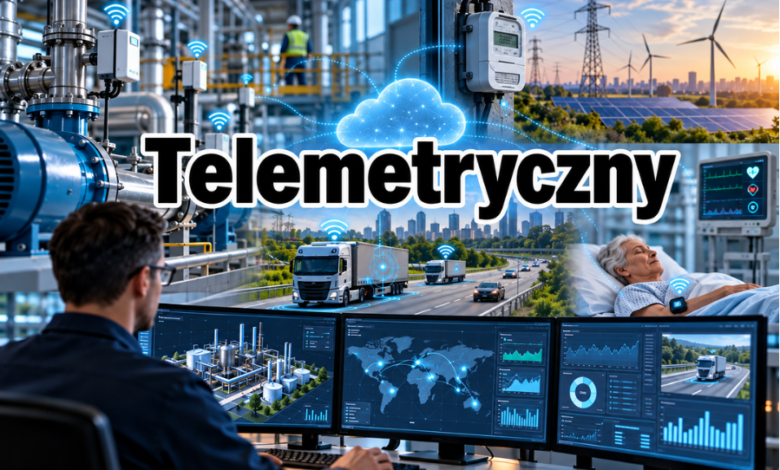
A smart electricity meter sends consumption figures without a householder taking a reading. A hospital monitor relays a patient’s heart rhythm to clinical staff. A delivery vehicle signals that its engine needs attention before a driver notices a problem. These different technologies share a defining capability: telemetry.
The Polish word telemetryczny describes something connected with that capability. In English, it generally translates as “telemetric” or “telemetry-related”, rather than naming a particular device, company or software product. Understanding the term opens a wider story about the infrastructure quietly supplying measurements to businesses, public services and connected homes. That flow of information also raises questions about reliability, security and data access.
What Telemetryczny Actually Means
In Polish, telemetryczny is an adjective derived from telemetria, meaning telemetry. It describes a system, process or piece of equipment that measures information and transmits it to another location. The purpose is to understand conditions without visiting the measuring instrument.
Its form changes with the noun it describes. System telemetryczny means telemetry system; karta telemetryczna can refer to a SIM card used for machine-to-machine communication; and dane telemetryczne means telemetry data. Such distinctions matter in technical specifications and service contracts.
The English equivalent is normally “telemetry” when discussing the general technology and “telemetric” when describing a particular component. The term is not synonymous with GPS tracking, artificial intelligence or surveillance, although some systems combine those functions.
How a Measurement Becomes Useful Information
A telemetry installation begins with a source. Sensors may measure temperature, pressure, voltage, movement or heart rate. Software can perform a similar role by recording response times, errors and workload. Each reading needs context, such as a timestamp, device identifier or measurement unit, to make sense later.
Next comes transmission over mobile networks, Wi-Fi, cables, radio or low-power networks. A remote agricultural sensor has different battery and coverage requirements from a factory machine connected by cable.
At the receiving end, a platform stores, displays or analyses incoming records. Operators might see a dashboard, receive an alert or integrate measurements into another operational system. Some devices process readings locally and transmit only exceptions, saving bandwidth and reducing unnecessary traffic.
Crucially, monitoring and control are different functions. Telemetry sends observations; a command system can send instructions back. Many installations support both, but receiving an alarm does not automatically mean the system can safely intervene.
Where Remote Monitoring Makes a Difference
Energy: More Than an Automatic Meter Reading
Smart meters show the everyday value of sending measurements remotely. In Britain, connected gas and electricity meters can provide consumption readings to suppliers, while an in-home display helps households see usage patterns. Electricity readings can be updated much more frequently on the display than traditional manual meter checks allowed.
This supports billing and exposes changes in energy use. At network level, aggregated measurements can help operators understand demand. However, a meter by itself does not reduce consumption; savings depend on how households, suppliers and networks use the evidence.
Data access is also important. Detailed consumption patterns may reveal aspects of household routines, which is why the frequency and purpose of data sharing deserve attention alongside convenience.
Healthcare: Continuous Signals, Clinical Judgement
In hospitals, telemetry commonly refers to remotely displaying patients’ physiological signals, particularly cardiac activity. Wireless monitoring can allow clinical staff to observe changing heart rhythms while patients are away from a fixed bedside monitor. Other remote-monitoring arrangements can collect measurements outside hospital settings.
The clinical value is timely visibility, not automatic diagnosis. An unusual reading must be interpreted in context, and a weak connection, misplaced sensor or false alarm can affect what staff see. A well-designed programme therefore requires suitable devices, escalation procedures and people capable of assessing the results.
Health data is particularly sensitive. Reliable medical telemetry depends as much on clinical governance and confidentiality as it does on wireless connectivity.
Transport and Industry: Finding Problems Earlier
Fleet managers may use vehicle telemetry to examine fuel use, engine faults, location and driving conditions. Those data points can support maintenance planning and route decisions. GPS provides location, but telemetry can extend beyond position to reveal what a vehicle or its components are doing.
Factories use comparable systems to observe temperatures, vibrations, equipment status and operating pressures. An unusual trend might prompt inspection before a machine fails, although prediction requires historical evidence and appropriate analysis. A sensor warning is a reason to investigate, not proof that a breakdown is imminent.
Remote assets such as water pumps and storage facilities are especially suited to this approach because regular physical inspections take time. The economic case depends on the cost of missed failures and the usefulness of the measurements collected.
Software: Telemetry Without a Physical Sensor
Modern applications produce their own operational signals. A service may record how long a request takes, whether it fails and which component handled it. Engineers use those observations to diagnose outages and improve performance across complicated cloud systems.
OpenTelemetry, an open-source observability framework, helps organisations generate, collect and export common signal types including metrics, traces and logs. Metrics summarise quantities, traces follow requests through connected services, and logs capture events. Together, they provide a more complete picture than a single error message.
Software telemetry can also include diagnostic usage data. That introduces a crucial distinction between collecting what is necessary to keep a product working and collecting additional information about how people use it.
Spacecraft: A Long-Established Application
Long before connected homes became commonplace, spacecraft relied on telemetry to tell ground teams how onboard equipment was performing. NASA describes measurements such as component temperatures, electrical voltages and spacecraft orientation among the information transmitted to Earth.
Telemetry is not defined by the internet, but by measurements travelling somewhere they can be interpreted.
The Difference Between Data and Understanding
A telemetry dashboard can look precise while still conveying the wrong impression. A temperature spike might indicate overheating, a sensor fault or a change in operating conditions. Without calibration, context and sensible thresholds, more data can simply produce more confusion.
Timing matters too. Some systems transmit continuously; others report every few minutes, once a day or only after a particular event. “Real-time” should not be assumed from the word telemetryczny alone. Communications delays, power-saving settings and temporary network outages can affect when readings arrive.
Good systems record measurement units, device status and missing readings. They also allow operators to distinguish an actual zero from a sensor that stopped transmitting. Those apparently small design choices determine whether people can act confidently on the results.
Privacy Is Part of the Engineering
A machine’s operating temperature might reveal little about an individual. A vehicle’s location, a wearable’s physiological readings or a household’s energy pattern can tell a different story. When data relates to an identifiable person, its collection and use may fall under privacy law.
In the UK, the Information Commissioner’s Office has emphasised data protection by design for consumer connected products. Its updated 2026 guidance addresses telemetry and diagnostic information, including the need to distinguish essential functions from non-essential collection. UK GDPR and, where applicable, electronic privacy rules shape how organisations handle such information.
Responsible deployment means identifying the purpose of collection, limiting unnecessary data, explaining access and setting defensible retention periods. Consent may be required in particular circumstances, but it is not the only possible lawful basis under data-protection legislation. The rules depend on what is collected and why.
A useful design question is whether a system truly needs individual-level history or could achieve its purpose with aggregated or shorter-lived records.
What Can Go Wrong With a Telemetry System?
Connectivity is an obvious weak point. A device installed underground, in a remote valley or within a metal enclosure may have intermittent coverage. Battery-powered equipment must also balance frequent transmissions against power consumption and maintenance costs.
Security failures can be more serious. Attackers might intercept sensitive transmissions, impersonate devices or manipulate measurements. Protective measures include authentication, encryption, securely managed updates and controls over which users and systems may access readings. The UK’s National Cyber Security Centre treats secure communication and monitoring as important connected-device design principles.
Then there is operational risk. Too many alerts can overwhelm staff, while poorly configured thresholds may miss a developing fault. Remote monitoring should complement clear maintenance, response and recovery arrangements, not replace them.
What Buyers Should Ask Before Choosing Equipment
The best telemetry system is not necessarily the one with the most sensors or the most detailed dashboard. Its value depends on a specific decision it helps somebody make: dispatching a technician, changing an operating schedule or checking a potentially dangerous reading.
Before procurement, organisations should establish what must be measured, how quickly an alert is needed and how communications will work at the intended location. They should also examine data ownership, compatibility with existing software, service costs, security updates and what happens when the connection fails.
A small pilot can reveal whether the collected measurements are genuinely actionable. It may also expose costs that are easy to miss in a product demonstration, including installation, calibration, connectivity, storage and staff training.
The Next Chapter: Smarter, More Selective Monitoring
Telemetry is becoming more closely connected with edge computing and automated analysis. Instead of transmitting every raw reading, a device can evaluate data locally and send a summary or warning. That may reduce network traffic and support faster responses when connectivity is limited.
Artificial intelligence can help identify patterns in large datasets, but its conclusions remain dependent on accurate inputs and testing against real operating conditions. An unreliable sensor does not become trustworthy because its output feeds an advanced model.
The meaningful direction is not simply toward collecting more. It is toward collecting the right measurements, protecting them appropriately and connecting them to decisions that improve safety, efficiency or service quality.
Conclusion
The meaning of telemetryczny is straightforward: connected with measuring and communicating information at a distance. Its practical significance is far broader. From cardiac monitoring and energy meters to cloud software and spacecraft, telemetry makes distant conditions visible. Its success rests on accurate measurement, dependable transmission and responsible use of what those readings reveal.
FAQs
What does telemetryczny mean in English?
Telemetryczny is a Polish adjective usually translated as “telemetric” or “telemetry-related”. It describes technology that collects measurements and communicates them to another place. The exact translation depends on the phrase: system telemetryczny means telemetry system, while dane telemetryczne means telemetry data.
Is telemetry the same as GPS tracking?
No. GPS is a positioning technology, whereas telemetry concerns transmitting measured information. A vehicle tracker may use GPS coordinates as one telemetry input, alongside engine status, speed or fuel-related readings. Many telemetry applications, including hospital monitors and electricity meters, do not need GPS at all.
Does a telemetry system require internet access?
Not necessarily. Measurements can travel over private radio, wired networks, mobile connections or other communications channels. Some installations eventually send data to an internet-connected platform, but internet access is not what defines telemetry. The appropriate method depends on distance, power requirements, reliability and security.
Can telemetry collect personal information?
Yes. Location histories, health readings, usage patterns and device identifiers may relate to identifiable people. Organisations must assess the information being collected, its purpose and the applicable privacy requirements. Technical data is not automatically anonymous simply because it comes from a machine rather than a form.
What is the biggest benefit of telemetryczny technology?
Its central advantage is visibility without constant physical inspection. Reliable remote readings can help people detect changes, investigate faults and make informed decisions sooner. The benefit is not guaranteed, however: useful outcomes depend on sensor accuracy, communications reliability, appropriate analysis and a clear response when something requires attention.